


Why One Table Can Be Worth $30,000

Meet One of the Rarest Tables You Can Buy

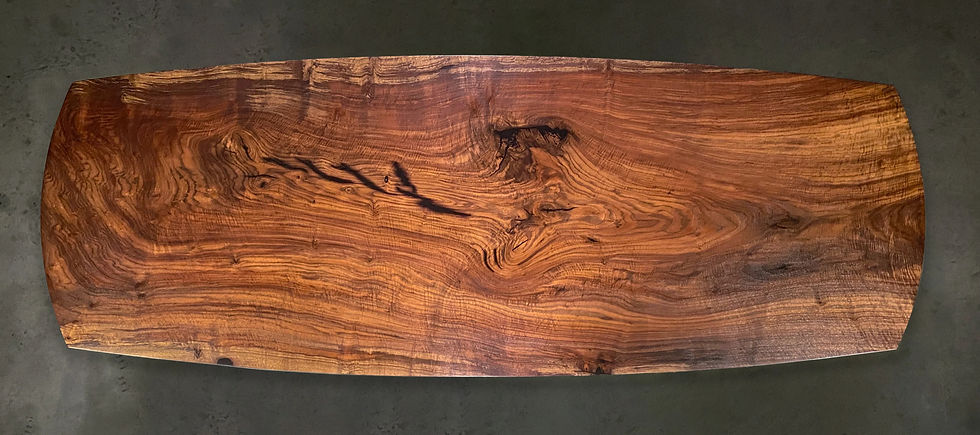
At The Run For A Million next month, we'll be bringing something truly extraordinary to our booth—a dining table crafted from a single slab of California Claro walnut. We call it the Willoughby Dining Table.
At first glance, it's easy to admire the rich colors, flowing grain, and sculptural silhouette. But what most people don't realize is that tables like this are among the rarest pieces of furniture in the world. Their value isn't simply found in the craftsmanship—it's rooted in the tree itself.
A Tree That Took Generations to Grow
To produce a dining table from a single slab, the walnut tree must be exceptional. Not just old, but massive.
The trunk has to be wide enough to yield a slab more than three feet across, long enough to span an entire dining table, and healthy enough to do so without major defects. Out of thousands of walnut trees harvested, only a small fraction ever produce a slab worthy of becoming a luxury dining table.
Once a tree like this is gone, there will never be another exactly like it.
Why Claro Walnut Is So Coveted
California Claro walnut has earned a reputation as one of the most beautiful hardwoods in the world.
Unlike traditional black walnut, Claro is known for dramatic movement and color. Rich chocolate browns blend into warm caramel tones, while swirling grain patterns, feathering, curl, and natural figure create a surface that feels more like a work of art than lumber.
No two slabs are ever alike.
Every shift in color and every ribbon of grain tells the story of decades—sometimes more than a century—of natural growth.
One Tree. One Slab.

Many high-end dining tables are created by joining two or more slabs together.
There's nothing wrong with that—it allows beautiful wood to be used efficiently and can create stunning furniture.
But a true single-slab table is something entirely different.
Every inch of the tabletop comes from one continuous slice of one tree. The grain flows uninterrupted from one end to the other, creating a seamless piece of natural artwork that simply can't be replicated.
It's one of the defining characteristics collectors and luxury homeowners look for.
Years Before the First Cut
Building a table like this doesn't begin in the woodshop.
After the tree is harvested, it heads to the sawmill to be sliced into slabs. Then an incredibly meticulous drying process begins in a vacuum or dehumidifier kiln. Placing either of these processes into uneducated hands can cause cracking, twisting, checking, case hardening, or internal damage that ruins the wood.
Only after the slab reaches a moisture level between 6-8% can it finally be flattened, stabilized, sanded, and finished by hand. The result is furniture that wasn't rushed—it was patiently crafted.
More Than Furniture

People often ask why a table like this commands such a premium. The answer is simple.
You're not just buying a dining table.
You're buying a once-in-a-lifetime piece of nature that took generations to create and countless hours to preserve. You're investing in something that will never be duplicated because the tree it came from will never exist again.
Long after trends have come and gone, this table will still be gathering family, friends, and stories around it.
That's what makes it so valuable.
See It in Person at The Run For A Million
We'll be bringing this remarkable dining table to The Run For A Million, August 11–15, at South Point Hotel & Casino in Las Vegas.
If you're attending, we invite you to stop by our booth and experience it for yourself. Some pieces simply can't be appreciated through a screen. You need to run your hand across the grain, see the depth of the wood in person, and understand why tables like this become family heirlooms.
We'd love to share its story with you.


Comments